
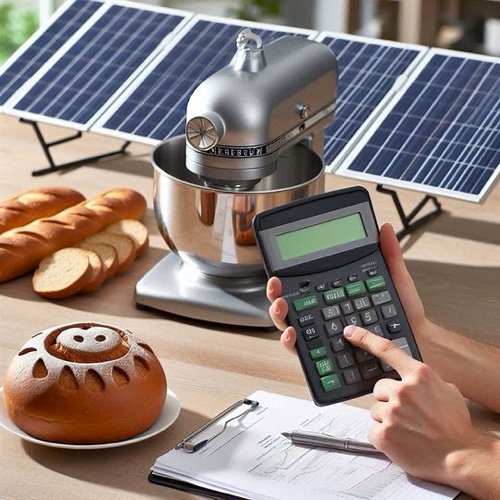
Calculating your solar power needs looks different depending on how you define “needs”. This image was generated by AI (Microsoft CoPilot) but the details below are about you generating your own solar power calculations.
Alrighty then! Calculating solar power needs for getting power in the house! Wait . . . Have you decided what you want to power with solar? Do you know what I am talking about? If the answer two both of those questions is “no” then you should go back and read my foundational posting – “Getting Started In Solar – Ep. 0” – https://hopethiswerks.com/getting-started-in-solar-ep-0/.
Before we start talking about calculating solar power needs, consider these important reminders or disclaimers:
- Electricity be dangerous.
- My advice is based on my experience. I haven’t died yet.
- I am not a trained electrician.
- Wherever possible, I avoid math (check my work!).

How Much Solar Power Do I Need?
This episode is about your journey into using solar power and taking the next step to calculating how much solar power you need. If you have determined you want to power your whole home continuously using solar power, this information may not be useful. If that’s your situation you may want to consult a professional in this area (and your financial advisor). About 7 years or so ago we consulted with a well-known alternative energy company and we were advised we could power our house at about 30% capacity for about $180,000.
The good news is that the price of solar equipment is coming down. Despite the decreasing costs, being able to power everything in your home all the time is going to require quite a large, and complex (and costly) setup. Depending upon where you live and how your house is setup, it may not be feasible to take this approach.
Here’s what you can expect as you read:
- We are going to focus on calculating power consumption for some items inside a home in the United States – which is running 120v (often referred to as 110v) alternating current (or AC).
- Main Concept: You will understand how to determine the amount of power each item you want to power will require. Then you’ll have a pretty good idea of what you need to get from the sun to power those items.
- Later, but not now, we are going to address using solar power with direct current (or DC) to power something – maybe in your home or an RV or something similar. But, if you understand what I’m trying to say now, that topic will be super easy.
In the coming episodes (like Ep. 2 – which is actually already done) we’ll cover other details, like what to use to access that power (panels, charge controller, batteries, inverters, etc.). When this series is over it is my HOPE that you feel comfy enough to apply these concepts on your own.

Examples to Follow
Since it would be impossible for me to correctly guess what it is you would like to power with the sun, I will try to give a few examples for you to follow. Thus, the plan here is for you to use these instructions as a guide in your process.
Here are my intended examples:
- Bread Mixer (something you can plug into an outlet);
- Water Kettle (something you can plug into an outlet);
- Well pump (something that is hard-wired);
- Overhead lighting in a room (something that is hard-wired).
If you are thinking that none of those are really relevant to your situation, don’t worry. The point is less about the actual examples and more about how to make your calculations.
Remember, I am not talking here about connecting the solar power to the item you want to power. I admit that I do “go there” a little in the detail below. But for now we are still at square one – or at least near it – coming up with the answer to the question of how much power you might need.

Measuring Consumption To Get To Capacity
If you read this far, you probably have some idea what it is you want to power in your house. Now how much power is used by whatever it is you want to power by the sun?
You can measure the power consumption over time or at least calculate a pretty good estimate. And this is precisely what you need to do. Let’s get specific about how you get there.

But What Are We Trying To Solve?
Part of your goal is to figure out how much power you need so you can ultimately determine the battery capacity your system requires. This is not as difficult as trying to determine how to get the right power to your flux capacitor. The goal here is calculating power consumption. So while, we aren’t trying to focus on batteries, it is kind of important to begin with the end in mind. Still sounds a little like Back to the Future, eh?
Most batteries that I use have their capacity stated in “amp hours” or “Ah”. Some people refer to “amp” by their technical name “ampere”. That sounds way too nerdy to me, so I will use “amps.” Besides I like nicknames better anyway.
The amount of amp hours you need is what you are trying to figure out. But what is an “amp hour”? Don’t be scared! This is all fairly basic, trust me.
Think about an “amp hour” rating on a battery as a way to determine how many amps of power can be used in one hour. So, if your battery says it is “40 Ah”, you know that it can power 40 amps worth of gadgets for one hour. A typical electrical service for a home might be somewhere around 100 and 200 amps. That doesn’t exactly mean if you have a 200 Ah battery that you could power your whole house for an hour since there are more factors in play.
See, that wasn’t too bad, right?
Ultimately, you want to pick your battery’s (or batteries’) size based on the amount of amps you anticipate consuming over time.
Real quick, before go further into figuring out your power needs, let’s list out a few important mathematical / electrical concepts. I hate math. My college and post-college path was designed to avoid math. I can do it, but at the same level that I can swim – doggie paddle. For this purpose, to get us all doggie paddling in the same direction, these formulas will be helpful:
AMPS = Watts divided by Volts
WATTS = Amps times Volts
VOLTS = Watts divided by Amps
Should you need to convert or calculate things on your own, you may find these useful. These will also likely come up as we dive further into the details.
Without further ado than the “ado” we’ve had so far, let’s run through my example situations and figure out how much power we’d need in those examples – specifically concluding on how many amp hours we need.
Measuring Power Consumption - Plugged-In Devices
A few paragraphs above, I mentioned that we are going to talk about 4 different situations – two of which relate to items that are plugged into an outlet. Those are a little easier to measure power consumption over time since you can get a tool for it.
You need to buy one of these:

That one is called a KILL-A-WATT. Please excuse the violent-sounding name. You can buy one of these at several locations or through several suppliers. Here’s one (at my affiliate link – through which I earn commissions but the prices are the same for you. Feel feel to help a guy out.): https://a.co/d/gvMXml0.
[Check out some of the other options while you are at Amazon, since they seem to have some with cool features. The one I have loses all the info as soon as you pull it out of the outlet – which can be mondo annoying if you have been tracking power usage for a week. Don’t fall victim to my rookie mistakes!]
Example 1: Bread Mixer
This example sorta freaks me out a little bit, because I think that the torque in this machine is pretty serious. It also makes me worried that if I really had to power this machine, and I failed, the other contributing author to this blog site would have some “words” to share with me.
Winnie’s bread mixing machine is an Ankarsrum. If you don’t know what that is, no worries. You can see it here https://a.co/d/j4mhT19 – shameless plug / affiliate link. If you want to know more about why you would use one of those check out her posts about fresh-milled bread and related topics. https://hopethiswerks.com/health-benefits-of-fresh-ground-flour/
Full disclosure: You can also look at something like a product manual to help you determine power needs of a particular appliance. But that’s boring . . . and yet I will still discuss later.
Now FINALLY comes the fun part: the Kill-A-Watt meter shows me that I used 0.48 KWH (Kilowatt Hours) over a time number of 673 hours. Let’s do this:
- Convert “KWH” to Watt-Hours: There are 1000 watts in a kilowatts so multiply by 1000 makes 0.48 into 480 Watt-Hours.
- But I need to get to Amp-Hours. Considering my formulas above – take the 480 (WH) divided by Volts – which I know is 120V. 480 divided by 120 = 4 Ah.
- But remember it only used 4 Ah over 673 hours (or if broken down about 28 days). In fairness, not sure why, but usage was light over that time. This means it is around 4 Ah per month. Or 0.13 Ah per day.
That’s not so much. I can get an affordable, small battery to run that machine and it should be no problem. (Example: https://amzn.to/4efNVAO – yeah, that’s an affiliate link. I do have a battery that brand and it works great!)
Most people are not satisfied with merely powering their bread mixer with solar energy. I dunno, seems like a worthy goal to me. Nothing says, “It’s all gonna be OK” during a zombie apocalypse like fresh bread dough.
Who doesn’t want fresh bread dough during an apocalypse. Also, even for this, I’d need some other pieces – like an inverter which takes the 12 volt power from the panel and converts it to useable 120 volts (normal house power). A low cost inverter is an option if this is something you might want to do. https://amzn.to/4exDf00 (Same story as the others. I don’t have this, but I have and enjoy other Renogy components.). I can’t help talking about next steps here, but don’t lose sight of the calculation concepts here. In later posts, we’ll cover going from sun to batteries and to actually using the stored power.

Example 2: Cosori Hot Water Kettle
If hot water at tea time while you’re off-grid is your jam, well this example might be fun. I am thinking of a Bluetooth-enabled hot water kettle. We beat the snot out of this and have for years. (https://amzn.to/4ehfKbM – not gonna say it. You know.)
The results here surprised me. I guess I am kinda shocked that the power to heat water is apparently way more intense than running a spinning motor with some decent torque. Who knew? You probably did . . . I didn’t.
- KWH: 0.46
- Watt Hours: 460
- Amount of time lapsed: 22.57 (the mixer was 30 times more than this!!!!)
- Amp Hours or Ah: 460 divided by 120 (that’s the volts) = 3.83 Ah
- In this case it is about 4 Ah per day!
Still seems like I could power both of these (or either) with a small battery and inverter. In total, I’d need around 4 Ah per day to keep my batteries topped off. I would probably need about one or maybe two (depending on average sun) 100 watt panels to keep this going and a 100 Ah battery would be ideal. Estimating about 5 hours of sun per day. Oof, I really have to stop – more on sun and panels later. Sorry!

Example 3: Well Water Pump
The situation with this example is tough for a few reasons. I’d say it seems like most, but not all, well pumps are set up on 240 volts. You can power these with solar, but it makes it weird if the rest of your home system needs 120 volts. What did I do? I replaced my well pump with one that runs on 120 volts. And actually, I paid someone to do that for me. Why? Well, having water when the power goes out is pretty important to me. If you don’t have a well, this is still a good example of calculating power needs.
Let’s use an example well pump – just to show the concept. Items wired directly to your electrical panel require some estimation because you can’t attach a meter as easily to check the power usage. I suppose you could wire the Kill-a-Watt meter to the panel, but I am not recommending that and I have not tried it. Don’t do it.
Instead, look for the specifications for the well pump. My example pump has this key fact: it draws slightly under 8 Amps. Average water pumps could run for a while, but let’s estimate 8 hours per day. Amps multiplied by the number of hours I need to run the pump equals “Ah” or amp hours. In this case that’s 64 Ah.
I might want to use the upper-end tolerance in amps for this pump, which is 11 amps. In that case my potential Ah is 88.
In case you wanted to calculate power for all of these items we’ve discussed, you can see we’d need around 70 Ah per day: (less than 1 Ah for the mixer, around 4 Ah for the kettle and 64 for the well pump (or 88 Ah worst case). This could be one 100 Ah battery, in theory.
For reference, I used this well pump because I could find the manual and amp specs: https://www.waterpumpsdirect.com/Grundfos-Pumps-96160164-Water-Pump/p80403.html. They may be great, I don’t know. If you have a different pump (using what is called either 115v or 120v) look at your manual for more info on amps drawn.
Complicating matters is that you can’t really plug stuff in if it is wired to your house electrical panel. What I mean is, for example – think about the mixer example – that plugs into an outlet, so I could plug it into something that is storing solar energy. But, a well pump (or an overhead light) doesn’t have an easy way to change the power source since it is mechanical connected to your house. Baby steps – remember we are simply working on the part that focuses on how much power you need.
Example 4: Overhead Light
If you can find a manual for your overhead lighting fixture, then check the specifications for the amps that it uses. If not, maybe you can find the max watts (for the bulb) and you know that house voltage is 120. Here’s a spot where the formulas above might help – AMPS = WATTS / VOLTS. In my case, I used this example:
I’m simply using the specifications on that site for reference. Based on this, I know that we are talking about a 30 watt max bulb and we are using 120 volts in the house. This gives me 0.25 Amps. I expect that the light will be on about 5 hours per day on average, thus requiring about 1.25 Ah.
All in, I could power all these items with a 100 Ah battery. I suppose you could say, “but my solar power system is going to be 12 volts, not 120.” That’s fair, but the power to the light will be 120 volts – because that’s how most people have set up their existing homes in the US. The inverter (that thing I keep talking about but then saying, we’ll talk about later) goes between the batteries and the items in your home. (That inverter will also draw some limited amount of power as it converts electricity from 12 to 120 volts.)

CONCLUSION
That was a lot of material. The goal was to help you get familiar with how to calculate solar power needs for whatever it is you want to power in the home. Please use the examples to take the key next step here – which is to catalog the amount of power consumption you need to account for when it comes to the items you want to power with solar. You may ultimately find that you’ve got a plan that doesn’t fit your budget, your roof, or you comfort zone. My suggestion is to start big and pare down to some of the key items (or THE key item) that you want to power if you need to make a more realistic plan. Don’t get discouraged! If I can do this (and survive) so can you!
Some things to look forward to:
- We’re going to cover how to handle 12 volt electricity situations – for those folks who are looking at using a setup in their camper.
- We’re going to talk about how to size the solar panels to fit your consumption / batteries.
- We’ll go through some more real examples or at least practical examples that should help round out what you’ve read.
- We’ll figure out how to power your home using the power of potatoes! (Not really – just trying to tie in the above pic.)
Of course, if you don’t want to take my word for it on the overall topic here (and I wouldn’t blame you):
- https://www.saveonenergy.com/resources/energy-consumption/
- https://www.ucdenver.edu/centers/center-for-inclusive-design-and-engineering/community-engagement/emergency-preparedness-services-new/surviving-in-place/backup-power-options/how-to-calculate-your-power-needs
- https://www.youtube.com/watch?app=desktop&v=cX4s-bxn4fs






2 responses to “Getting Started In Solar – Ep. 1 (Calculating Solar Power Needs)”
Great introduction. I can’t wait to read more.
Thank you so much! I’m so glad you enjoyed it.