
I love bread. Always have. But until recently, I used to think that I should not eat it. Am I alone in feeling guilty if I finish the crust when eating pizza? Things have changed for me recently. What if bread made with fresh ground flour was different, perhaps even healthier than store-bought bread?

When was the last time you thought about flour? I mean really thought about it. Not the “Oh, I forgot to buy flour for the third time this week” thinking, but the deep, reflective, soul-searching pondering about the powdery substance that holds our cakes, breads, and pizza doughs together. If you’re like most people, you probably buy a bag of flour, throw it into your pantry, and forget about it until you’re elbow-deep in cookie dough.
Three Parts of a Wheat Kernel
The first step in really thinking about flour is to know where it comes from. Throughout all time, wheat flour is made by crushing a wheat kernel. This was true in BC times and it is still true today. Let’s begin by identifying the three parts of a wheat kernel: bran, germ, and endosperm.
Bran
This is the outer layer of the wheat kernel. It is rich in insoluble fiber (very important for constipation and diarrhea – more below), B vitamins, niacin, riboflavin (what in the world is this?), biotin, antioxidants, and many other nutrients.
Germ
This is the heartbeat of the wheat kernel. This part of the kernel houses everything needed to grow into a plant. (12) It is the most nutrient-dense part of the wheat kernel. It is rich in vitamin E, protein, folate, healthy oils/fats, B vitamins, antioxidants, thiamine, and tons of other nutrients (more information below).
Endosperm
This is the largest part of the wheat kernel (about 83% of the kernel’s weight). (12) This part of the kernel contains gluten (protein), starch, and the smallest amount of nutrients (stay tuned for further discussion).

a long time ago … there was fresh ground flour
Let’s stroll back into history. Bread has been around for thousands of years, starting in early BC times. Think about it: Bread could be made by smashing wheat kernels with a stone … mixing that with water … and leaving the dough in the sun to dry out. Bread has been discovered in archeological dig sites and ancient tombs. People have been enjoying bread for almost as long as they have been drinking water.

Mass Production of Bread
Time has brought changes to bread. Mechanical bread slicers, metal sorting rollers, and other bread developments have made their debut over the decades. These inventions helped establish commercial bakeries and also made it easier for commercial bakeries to increase bread production. As they produced more bread, they had a financial incentive to create a product that would be shelf-stable and uniform.
As the commercial bakeries made a shelf-stable product, they removed healthy portions of the wheat kernel (bran and germ). When the bakeries made the loaves uniform, they added unhealthy chemicals (more below). Do you see the downhill spiral happening to bread?

The Bad News - Adios Nutrition!
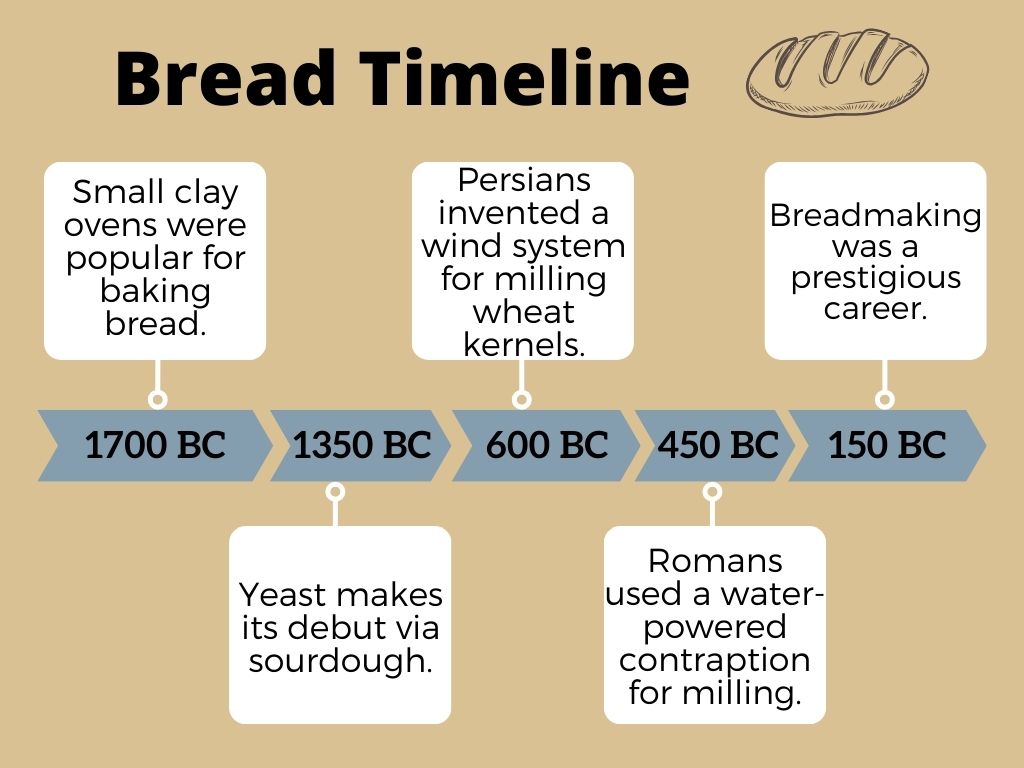
Did you notice on the timeline in the 1920s, grain millers devised a way to separate the three components of a wheat kernel? They cracked wheat kernels into its three sections: bran, endosperm, and germ. They decided to use only the endosperm, which is the whitest section of the wheat kernel with the least amount of nutrients (more to come).
The timeline also mentions that WWII soldiers (in 1942) suffered from poor nutrition. Many people around the world were experiencing new health problems (e.g. beriberi, pellagra, rickets, iron deficiency, birth defects, etc.). In the 1940s, recognizing this health crisis, the government urged mills to return the bran and germ to the flour. The mills refused because, over the past two decades, they had found a profitable market for selling the germ and bran as cattle feed. (3)
Alternatively, grain millers chose to “enrich” the white flour by adding 4 synthetic vitamin powders to the flour. These 4 synthetic vitamins (thiamine, riboflavin, niacin, and iron) do not make the bread healthy again. They do the bare minimum to stave off a few diseases (e.g., beriberi, pellagra, etc.). (3)
Chemicals added to Processed Bread
A bakery’s success is dependent on every loaf being uniform (the same amount of fluffiness and flavor – every time). Also, a commercial bakery needs to control how long the bread lasts on the shelf. Additionally, bakeries need the dough to endure aggressive processing by machines (versus Grandma’s gentle hands kneading bread on her counter). Here is an example of some of the chemicals that are added to processed bread to control these issues:
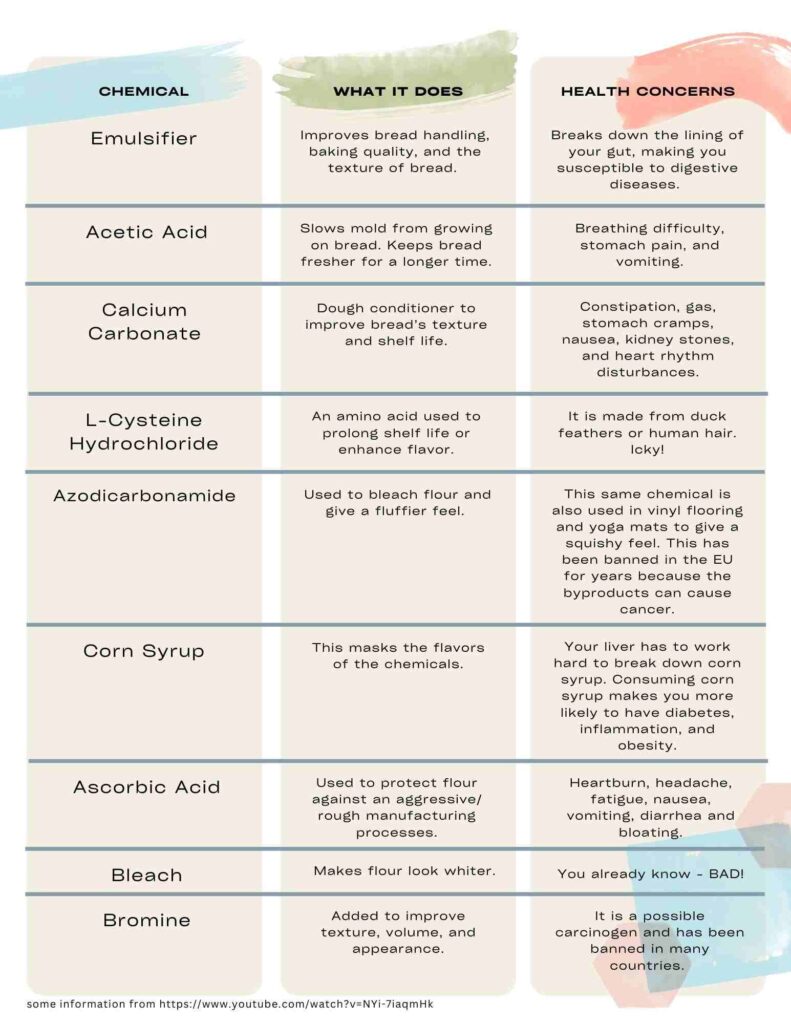
A commercial bakery must add many chemicals to their bread to make it uniform and shelf-stable. Additionally, they must strip away the bran (because it adds unwanted color and flavor) and germ (because the natural oils shorten the shelf-life). This is a far cry from the bread that people had been eating for thousands of years.
Whole Grain Bread from the Supermarket
You might be thinking, “None of this applies to me, because I buy whole grain bread from the supermarket.” I have some bad news for you. Let’s dive into this starting with a story.
Duke (my husband) is great at entertaining us with YouTube videos. He scours his YouTube feed during the day and we watch those videos at night. On Tuesday night he said, “You don’t get to pick which video we watch tonight. I KNOW I found a video you are going to love.” It was a video by Business Insider about ultra-processed bread. Yes! Duke knows me well!
Most of the information in this video was spot-on and very informative. However, at the end of the video, the accuracy of their information was lacking when they sang the praises of whole-grain bread purchased from the supermarket. These misconceptions might be widespread. Let’s clarify a few things…
Supermarket Whole Grain Bread vs. Homemade Bread with Fresh Ground Flour
Here is the question. Is whole grain bread from the supermarket as nutritious as bread made with fresh ground flour? Don’t they sound very similar! The answer to that question is simply, “NO!” You are about to read some life-changing facts about supermarket “whole grain” bread.
Strike 1 (against whole-grain supermarket bread) - Oxidization Steals Nutrients
Let’s start by explaining that once wheat kernels are crushed, the grain begins to lose some of its precious cargo. Nutrients immediately begin to oxidize and degrade faster than an avocado left out in the sun. A basic definition of oxidization is when oxygen mixes with a substance creating a chemical change. Adios nutrients! Within 24 hours after milling a wheat kernel, approximately 40% of the nutrients are depleted from oxidization. After 72 hours, 90% of the nutrients are gone. (3)
Most bakeries obtain their flour from a mill. By the time the flour reaches the bakeries, the nutrients remaining after the milling process have oxidized out of the grains. Often bakeries have their flour delivered once a month. Before being delivered to bakeries, the flour was sitting in a warehouse and is easily a year old by the time it reached the bakery.
Story Time: My first grandbaby arrived less than a month ago (my smile hasn’t left my face yet). I live in Pittsburgh, and my daughter and son-in-law live in Salt Lake City. My visit was going to last for 10 days. I called many bakeries to find bread made with fresh ground flour. My first question was, “Do you make your bread with fresh ground flour?” I rarely had the opportunity to ask a second question, because the answer was “No”. One time I had a glimmer of hope because they said “Yes”. When I asked if they ground the flour the day that they baked the bread, their answer was … “No, we order our flour once a month from a local mill. I don’t know when the mill grinds it.” We had drastically different definitions of “fresh ground flour!”
Strike 2 - Chemicals
Commercially made whole grain bread is made with their white flour (which has chemicals added and the bran and germ stripped from it). The bakery will then recombine the white flour with some of the bran and germ. Additionally, they often add brown coloring for appearance. This is not the same flour you would get if you freshly ground the flour. (3)
Strike 3 - Nutrients Lost to Heat
When wheat kernels are milled commercially, they are heated above 115 degrees. This destroys the heat-sensitive nutrients. When you mill wheat kernels at home, your mill stays at a much lower temperature. Therefore more nutrients are left in your flour. (4)
Strike 4 - Tastes Yucky
Let’s all be honest. Commercially made whole grain bread will never be a fan favorite. It tastes yucky. One of the benefits of fresh ground flour is that it tastes delicious. We all know that freshly ground coffee tastes better than the stale stuff sitting in your cabinet, right? Well, flour is the same way.
Freshly ground flour has a completely different flavor profile than the store-bought stuff. It’s nuttier, more aromatic, and has a slightly sweet, wholesome taste that you’ll never find in supermarket bread. And let’s get real: when you’re baking that loaf of sourdough or whipping up a batch of pancakes, wouldn’t you rather have the good flour? It’s like the difference between eating a store-bought cookie and a homemade one. Sure, both are technically cookies, but one will leave you with a smile and the other with a vague sense of regret.
This is one of those healthy trends that you will keep doing forever because it tastes so amazing. Some health trends are nasty and we try to make ourselves “do the healthy thing.” Not with this trend, this one is delicious and a lifetime keeper!
Strike 5 - Sugar
Commercially made whole grain bread uses large quantities of sugar. Whole grain bread is supposed to be healthier. I just compared a loaf of supermarket whole grain bread to Wonder bread. They had the same amount of sugar. Hmmmm… whole grain is advertised as healthier. That’s tricky!
Overall, if you have to buy bread, then “whole grain” is a tad better because it does have some bran and germ added back into the flour. It will never compare to the deliciousness or nutritional value of a loaf of freshly ground bread. Whole grain products from the grocery store are not that much better than their white bread friends. You will not experience significant health benefits from consuming the grocery store’s whole grain options.
The Good News ... da da da dah Fresh Ground Flour!
Enough bad news. Fresh ground flour is here to save the day!
Nutrients in Fresh Ground Flour
Freshly ground flour (containing the bran, germ, and endosperm) naturally contains a whopping 40 of the 44 nutrients the human body needs. (5) That is 91% of the nutrients your body needs. Do we see the problem? The bread was stripped of most of its nutrients when commercial bread makers removed the bran and germ. People have been tricked into thinking commercially made bread is healthy because they added 4 synthetic vitamins back to it. Reality check: America’s cattle benefits by eating the healthiest portions of the wheat kernels. (Remember in the 1940s, the grain millers didn’t want to put the germ and bran back into the flour because they made money by selling it for cattle feed. (3)) – Lucky cows!
I highly recommend that you go to Unsifted’s website. Below is a nutrient comparison chart of the nutrients in their fresh ground flour vs. white all-purpose flour. This chart compares 44 different nutrients. One example is that their fresh ground flour has 359 mg of potassium versus white all-purpose flour has 107 mg of potassium. Another fact is that their fresh ground flour has over 4x more Vitamin E than white all-purpose flour. (4) Remember Covid? It was impossible to buy zinc in any store. Fresh ground flour has loads of natural zinc.

The above chart is from Unsifted.com.
Would you rather feed your body 40 naturally occurring nutrients (calcium, magnesium, potassium, vitamin K, folate, zinc, vitamin E, phosphorus, selenium, vitamin B6, etc.) or chemically treated flour that has 4 powdered vitamins added to it? Need I say more? No, but I will…
Vitamin E in Fresh Ground Flour
I rediscovered vitamin E on my journey with fresh ground flour. Fresh ground flour is packed full of vitamin E. The richest source of vitamin E is found in the germ of the wheat kernel. The supplement for vitamin E does not offer the same benefits as those naturally occurring vitamin E in food. So you can’t get this as effectively in capsule form. (10) Remember, this is NOT one of the 4 vitamins that they add back into processed flour.
Why should I care about vitamin E?
It helps form every cell in our body … we can only be as healthy as our cells. (3)
It acts as an antioxidant, helping to protect cells from damage caused by free radicals … which can ward off cancer. (10)
It keeps your immune system healthy to fight off bacteria and viruses.
It has an important role in the anti-inflammatory process.
It is a natural blood thinner and widens the blood vessels, which helps prevent blood clots that can cause a heart attack.
It helps substances like vitamin A, carotene, pituitary, and adrenal hormones from being destroyed within the body.
Some research has shown that it might delay the progression of Alzheimer’s disease.(10)
It has been shown to be effective against some cancers, cardiovascular disease, asthma, allergies, diabetes, menstrual cramps, PMS, aging, arthritis, warts, macular degeneration, reproductive health, and cataracts.(3)
A diet that includes freshly milled bread … what the doctor SHOULD HAVE ordered!

Constipation or Diarrhea ... can fresh ground flour help?
Let’s address an extremely awkward topic: poop – more specifically, constipation and diarrhea. Many of the population suffer from constipation or the opposite problem, diarrhea. Weirdly enough, fresh ground flour can solve these opposite problems (woo hoo!).
Both problems stem from the same root problem … lack of insoluble fiber. We all know what fiber does, right? It keeps things, shall we say, moving. If you’ve ever had a conversation with someone who recently discovered the wonders of fiber, you’ll know they won’t stop talking about how regular they’ve become. Freshly ground flour can be the VIP pass to this club … if that’s something you’re into.
Our bodies need insoluble fiber (found in the bran portion of the wheat kernel) to properly prepare our food for elimination from our bodies. As chewed food makes its way through the digestive tract, it ends up in our colon. At this point, water is brought into the colon to mix with the insoluble fiber (from the fresh ground flour).
The good mixture of water and insoluble fiber:
- Swells the waste (poop) material. This naturally begins a contraction rhythm that our colon uses to move our waste down for elimination (toilet time).
- Makes our body’s waste (poop) soft and pliable so that it can be eliminated without cutting up our digestive system as it travels through it.
- Makes us feel full longer, therefore you eat less.
- The insoluble fiber from wheat has a unique scrubbing effect that thoroughly cleans the nooks and crannies of our colon.
- Our digestive system can properly extract the vital nutrients.
When we don’t have insoluble fiber (from the bran in fresh ground flour) to mix with the water in our digestive tract, the negative effects on our bodies are:
- We become constipated because the water in the colon does not have insoluble fiber to mix with.
- We can get diarrhea. Our colon becomes hyperactive trying to get rid of our waste. It sends extra water to our digestive tract to help eliminate waste (irritable bowel syndrome).
- We are hungry more often because there is no fiber to bulk up in our digestive tract. Therefore, we will have more cravings.
- Less nutrients are extracted because our food is not in our digestive tract for the correct amount of time.
- We can get rectal fissures (cuts – have you ever had blood in your poop?) because our waste is too hard as it travels during the elimination process.
- Hemorrhoids might also be a problem (from straining during potty time – not to be confused with party time).
- We get a build up of toxins because our waste is hanging out in our bodies for too long.
Discovering fresh ground flour is like discovering that the dusty treadmill in your garage could actually be a portal to another dimension where all your wildest dreams come true (you actually poop how you were made to). Intrigued? Fresh ground flour is the unsung hero of the health world. (9)
Gut Microbiome from Fresh Ground Flour: Your Digestive Tract’s New Best Friend
Fiber is also great for your gut microbiome, which sounds super “sciencey” but basically means that it helps promote the growth of good bacteria in your intestines. You can think of it like having a tiny, invisible gardener tending to the flora in your gut. And what gardener doesn’t love a good heap of organic material to work with? In this case, freshly ground flour is the compost that makes everything grow better.
Blood Sugar Control from Fresh Ground Flour: A Smooth Ride for Your Insulin
Here’s another fun fact: freshly ground flour can help regulate blood sugar levels. Because it contains bran and germ, it has a lower glycemic index than refined white flour. This means that it won’t send your blood sugar on a roller coaster ride that starts with “Wheee!” and ends with a face-plant in a bowl of ice cream because your energy levels just crashed.
The fiber in freshly ground flour slows down the absorption of carbohydrates, which gives your body more time to break them down and convert them into energy. It’s like trading your hyperactive toddler for one that calmly sits and colors inside the lines. Suddenly, everything is manageable.
Gluten Intolerance
When I was growing up, I don’t think I knew a single person that was gluten intolerant. Today, if you bring a meal to a new mom or someone who just had surgery … there is a pretty high chance they are gluten intolerant. It seems like many people today suffer from this.
I heard a story about a teenager (for fun, let’s name her Sally) who had a very bad case of gluten intolerance. Sally ended up in the hospital with complications. She lived a decade without eating bread. Her mother started a new hobby of making bread with fresh ground flour. Sally had heard stories of other people who had gluten intolerance and they could easily digest bread made with fresh ground flour. She decided to take one bite of her Mom’s bread. Her body stayed happy with her all day. The next day she ate half a piece of bread. Once again, her body didn’t get upset with her. On the third day, she ate a whole piece of bread … 12 years later … she is still eating bread made with fresh ground flour.
Sally is just one of many stories I have heard … about a grandma, mother, teacher, friend, aunt, neighbor … they all started their story with gluten intolerance and end their story with a lifetime of eating delicious bread made with fresh ground flour.
I mention this scenario with trepidation. Remember my disclaimer at the top … I am NOT a doctor. I just offer this as “food” for thought.
Other Health Concerns
Let’s end with a sweeping overview from other whole grain testimonies. People who have had a lifetime of eating commercially processed bread have found various levels of relief from the following conditions when they switched to eating bread made with fresh ground flour:
- nerve pain (neuropathy) (10)
- diverticular disease
- hiatal hernia
- heart disease
- diabetes
- obesity
- infertility problems
- varicose veins
- anemia
- allergies
- warts
- cardiovascular disease
- asthma
- menstrual cramps and PMS
- arthritis
- macular degeneration and cataracts
- reproductive issues
The good news is that many people who start eating fresh ground bread find relief from one or many of the items in this list. (3) Of course, every person is different and their experience with fresh ground flour will offer unique results. Please note it does not solve every problem. If you have a teenager, it will not relieve eye rolling, attitude problems, or miraculously get them to do the dishes.

Conclusion: Grind It Like You Mean It
At this point, you might be thinking, “Okay, freshly ground flour sounds great, but is it really worth the effort?” After all, buying a bag of flour from the store is convenient, cheap, and requires zero effort beyond lifting it off the shelf.
The answer depends on how much you value freshness, flavor, and nutrition. If you bake regularly and care about what you put into your body, then freshly ground flour could be a game-changer for you. It’s like switching from canned vegetables to fresh ones. Sure, the canned green peas will technically do the job, but there’s nothing like the taste and texture of fresh, vibrant, nutrient-packed produce. The same goes for flour. Once you’ve tried freshly ground, you might wonder how you ever lived without it. Your bread will have that rich, nutty flavor that can only come from real, freshly ground whole grains. It’s flour on a whole new level.
So there you have it, folks—freshly ground flour is the nutrient-packed, flavor-enhancing, fiber-boosting powerhouse you didn’t know you needed in your life. Sure, it requires a bit more effort than grabbing a bag off the grocery store shelf, but the health benefits are undeniable. Not to mention, your baking will taste like something straight out of a rustic, Instagram-worthy kitchen.
Time to bounce ... I need to make pizza dough with fresh ground flour for the weekend ... and I will be eating the crust!
If you would like a general overview of grinding wheat, here is another blog article that you might find interesting. If you need help choosing a grain mill, check out this article.

Disclaimer about Benefits of Fresh Ground Flour
I am not a doctor or a nurse, nor do I have any medical degrees. I am not giving medical advice. The statements and opinions are from my research, my experience and/or my opinions.
Resources:
- (1) https://breadvillage.com/blogs/breadmeister-talk/the-history-of-bread?srsltid=AfmBOopSITrqUtsXf3xk9IjvDgIVDNG2vrYr1lJBEajbwopUUum5s7V4.
- (2) https://nutrimill.com/blogs/life-in-healthy-balance/is-fresh-milled-flour-better-for-you#:~:text=Fresh%20flour%20can%20be%20milled,own%20flour%20just%20makes%20sense.
- (3) Bread Beckers, and Sue Becker. Bread Beckers Recipe Collection. 2005.
- (4) Unsifted, https://www.unsifted.com/pages/learn.
- (5) Reinitz, Thara. Health and Homeschool, 22 March 2023, https://healthandhomeschool.com/2023/03/22/benefits-of-fresh-milled-flour/. Accessed 10 September 2024.
- (6) Schiaparelli, Ernesto. “History of bread.” Wikipedia, https://en.wikipedia.org/wiki/History_of_bread. Accessed 20 September 2024.
- (7)Sirak, Megan. “5.” Colonial Williamsburg, 28 May 2020, https://www.colonialwilliamsburg.org/learn/recipes/bread-history-lover/. Accessed 11 September 2024.
- (8) National Center for Biotechnology Information, https://www.ncbi.nlm.nih.gov/pmc/articles/PMC3997530/. Accessed 10 September 2024.
- (9) “03: Digestion and Elimination.” YouTube, 16 February 2024, https://www.youtube.com/watch?v=YSLFGy9aKxE. Accessed 20 September 2024.
- (10) Mayo Clinic, https://www.mayoclinic.org/drugs-supplements-vitamin-e/art-20364144. Accessed 10 September 2024.
- (11) Some sentences, pictures or ideas may be from AI
- (12) https://www.wheatfoods.org/resources/wheat-facts/kernel-of-wheat/
Nutrient Comparison Table for Fresh Ground Flour:
| Nutrient | Fresh Ground Flour | Refined Flour |
|---|---|---|
| Fiber | High | Low |
| Protein | Moderate | Low |
| Magnesium | Present | Absent |
| Vitamin E | Present | Absent |
| Antioxidants | High | Low |
Store-Bought Bread Chemicals (not in Fresh Ground Flour):
| Chemical | What it Does | Health Concerns |
|---|---|---|
| Emulsifier | Improves bread handling, baking quality, and texture. | Breaks down gut lining, increasing digestive disease risk. |
| Acetic Acid | Slows mold growth; keeps bread fresher longer. | Breathing difficulty, stomach pain, vomiting. |
| Calcium Carbonate | Dough conditioner to improve texture and shelf life. | Constipation, gas, cramps, nausea, kidney stones, heart rhythm issues. |
| L-Cysteine Hydrochloride | Amino acid to prolong shelf life or enhance flavor. Made from duck feathers or human hair. | General ickiness due to source. |
| Azodicarbonamide | Bleaches flour; gives fluffier feel. Also used in vinyl flooring and yoga mats. | Banned in EU; byproducts can cause cancer. |
| Corn Syrup | Masks chemical flavors. | Liver strain; linked to diabetes, inflammation, obesity. |
| Ascorbic Acid | Protects flour during aggressive manufacturing. | Heartburn, headache, fatigue, nausea, vomiting, diarrhea, bloating. |
| Bleach | Makes flour look whiter. | Known to be harmful. |
| Bromine | Improves texture, volume, appearance. | Possible carcinogen; banned in many countries. |
Source: YouTube Video
Bread Timeline:
| Year / Era | Key Development |
|---|---|
| 1350 BC | Yeast makes its debut via sourdough. |
| 600 BC | Persians invented a wind system for milling wheat kernels. |
| 450 BC | Romans used a water-powered contraption for milling. |
| 150 BC | Breadmaking was a prestigious career. |
| 1000 | Medieval people used bread as their plate. |
| 1200 | In England, the Assize of Bread law was created to control bread prices. This law forced bakers to make a loaf that could be purchased for a penny. |
| 1700s | Bread was an important staple in the colonial American diet. The gentry preferred white flour (they had extra help that would refine their flour). The lower class relied on whole wheat flour (and lobster too). Sign me up for a low-class diet! |
| 1800s | Flour was milled locally and bread was baked at home. Since the flour could not be stored, the grain was ground fresh each day. |
| 1834 | The steel roller mill was invented. |
| late 1800s | Commercial yeast made its appearance (watch out sourdough, there is a new kid in town). |
| 1917 | A mechanical bread slicer was developed. |
| 1919 | A popup toaster was created. |
Bread Timeline Continues (Fresh Ground Flour):
| Year / Era | Key Development |
|---|---|
| 1920s | Millers devised metal rollers to separate the wheat kernel components (endosperm, germ, bran). By removing the germ and bran, the flour could be stored indefinitely (alert: this isn’t good). |
| 1930 | Most of the bread sold in stores was sliced. Sliced bread dries out quickly and is not shelf-stable. Commercial bakeries added chemicals to bread. Bread quality began to nosedive. |
| 1942 | During World War II, American soldiers suffered from poor nutrition and developed diseases. |
| 1942 | The US government mandated the fortification of white flour-based foods with 4 vitamins (thiamin, riboflavin, niacin, and iron). |
| 1960s | Bakeries increased production aiming to make a consistently soft white loaf of bread. More chemicals were introduced into processing. |
| 2020 | Sourdough wins every popularity competition. |
| Present Time | Micro-bakeries are popping up across America. |







2 responses to “Health Benefits of Fresh Ground Flour”
Wow, this was such an eye opener! I had no idea fresh milled flour had so many benefits. I just ordered a mill!
That’s amazing … welcome to the fresh flour club! You’re going to love the difference it makes.