
Welcome to

Hope this Werks

Fresh milled. Real Food. Pure energy.

Fresh Milled English Muffins with Yeast (Soft & Nooks-and-Crannies!)

Updated: February 3, 2026

I did a little research on the origins of english muffins. Honestly? I fell asleep halfway through. Therefore, I decided to spare you the same fate. Instead, let’s talk about something far more interesting … the tragic fact that most people have never had homemade english muffins, and even fewer have tasted fresh milled english muffins.

Frankly, this blows my mind.

Most of us grew up on Mr. Thomas and his polite little muffins with their pre-approved nooks and crannies. And listen … I loved them. You probably did too. However, once you’ve had a homemade english muffins (hopefully with freshly ground flour), it’s hard to go back. They’re softer, heartier, more flavorful, and somehow both rustic and indulgent at the same time.

Even better, these muffins aren’t just for breakfast. They moonlight beautifully as sandwich bread for lunch, rolls for dinner, or the base of a truly mind-blowing eggs benedict. Plus … and this is the part that makes people gasp … there’s no oven involved. Yes, really. We’re cooking these on the stovetop like rebellious little breads.

Also, yes… fork-splitting is absolutely a thing. We’ll get to that drama later.

At the bottom of this post, you’ll find two recipe cards:

  • One for freshly milled flour english muffins
  • One for store-bought flour (because accessibility matters)

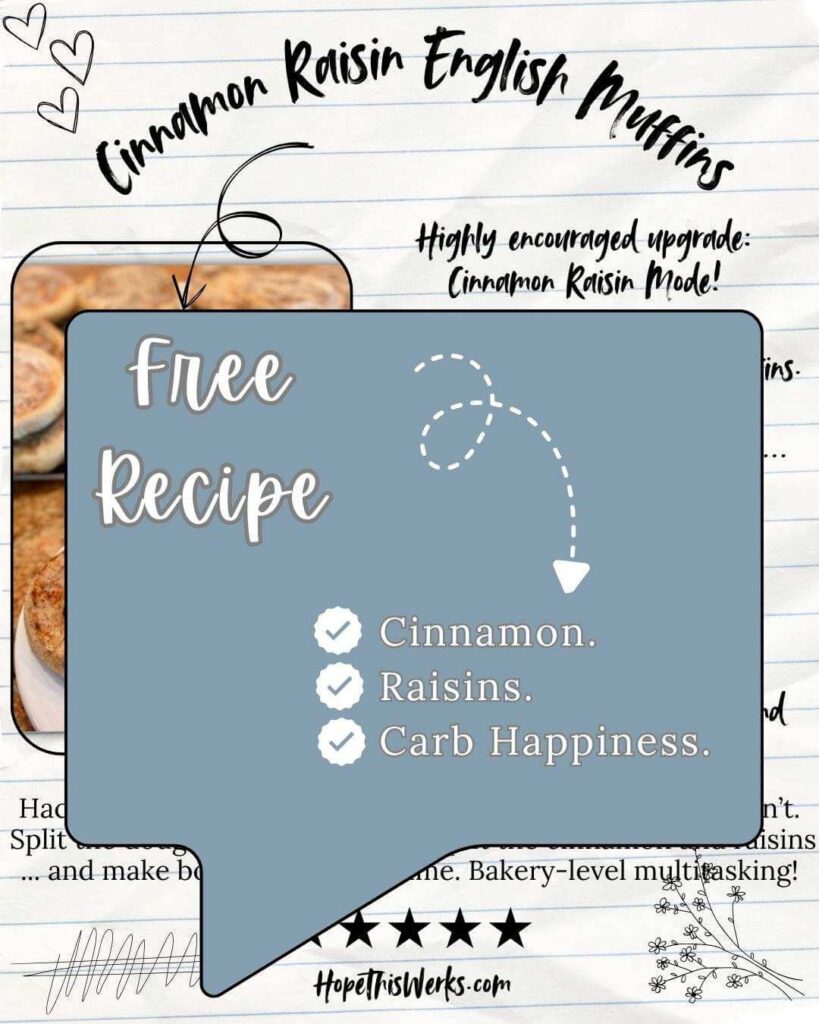
Ready for a little celebration? I also have a free recipe for cinnamon raisin english muffins. They’re out-of-this-world delicious and waiting for you to click right here.

So, let’s do this. Let’s get the world mildly obsessed with homemade english muffins … one craggy, butter-soaked bite at a time.

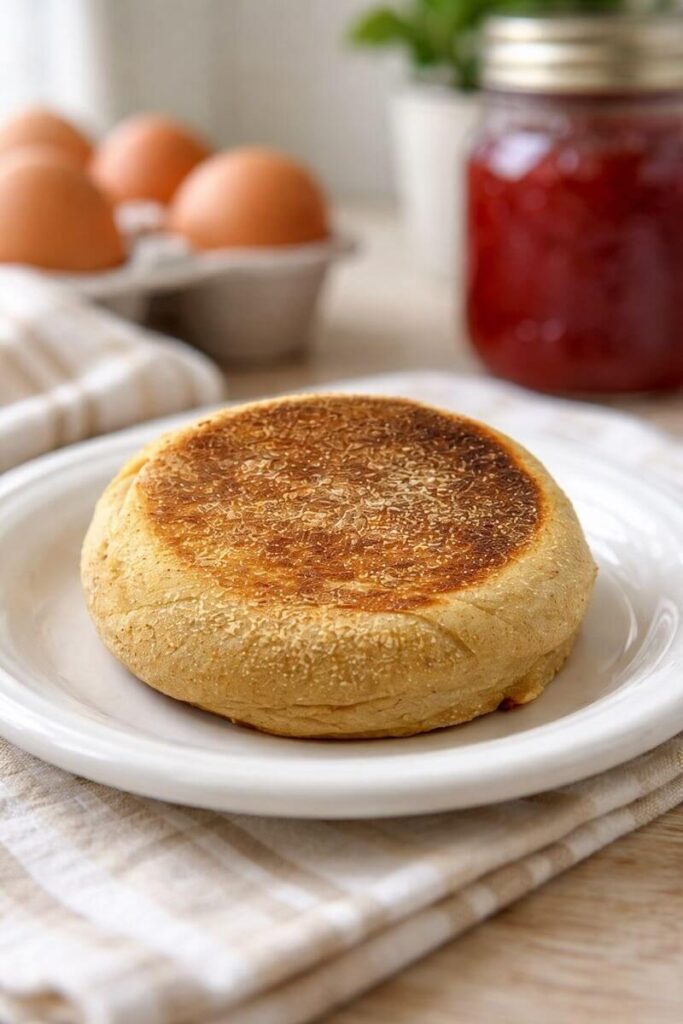
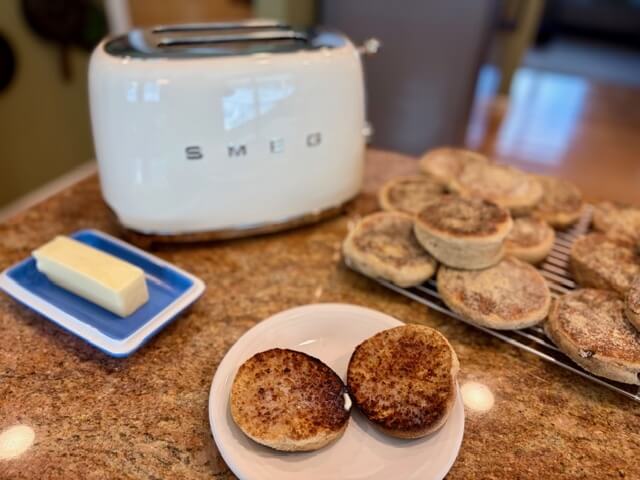
An freshly milled english muffin on a plate with eggs and jam in the background

Activating Yeast for Fresh Milled English Muffins

Before we do anything exciting, we need to wake up the yeast … gently. 

Start by combining:

  • 1½ cups milk
  • 1 cup water
  • ¼ cup honey

Now, we’re going to warm this mixture to 110°F. Personally, I pour everything into a large measuring cup and microwave it for 150 seconds at 50% power. Some people call that “2½ minutes.” They are correct.

However, do not skip checking the temperature. Yeast dies at 140°F, and it does so dramatically (screaming “I’M TOAST” on its way out). Thermometers save lives.

Once your milk mixture is warm and cozy, add:

  • 4 teaspoons yeast

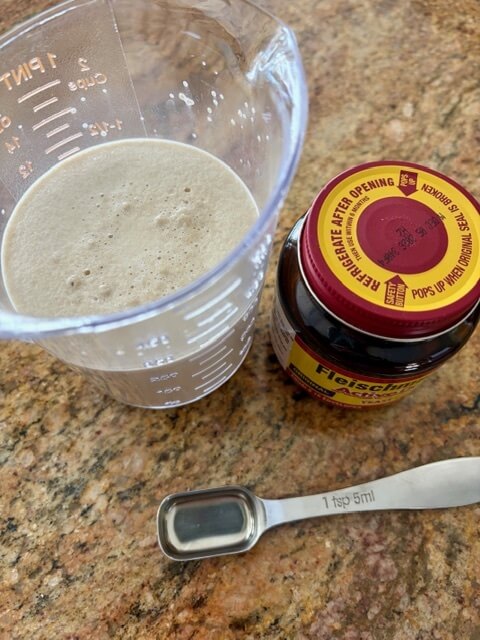
Give it a gentle stir and let it hang out for about 5 minutes. If it gets foamy, congratulations … your yeast is alive and ready to party.

Yeast Sidebar (Because Yeast is Confusing)

Let’s take a station break to talk about yeast for a second.  If you walk down the baking aisle of your local grocery store, you will run into the two most popular types of yeast:

  1. Active Dry Yeast (cheaper if you buy in bulk)
  2. Instant Yeast / Rapid-Rise / Bread Machine / SAF Red

They are basically cousins. Back in the day, active dry yeast was lazy and needed to be proofed in warm water to wake up. Instant Yeast, on the other hand, could be tossed straight in with the flour. But modern active dry yeast has changed a bit, and now you can skip the proofing step. 

That said, since I don’t bake with yeast constantly (hello, sourdough obsession) … I still proof it. Because honestly? I like knowing my yeast is alive before I commit flour to the cause.

Once your yeast is foamy, you’re officially cleared to proceed.

Bubbly yeast in liquid in a measuring cup next to the bottle of yeast and a measuring teaspoon for fresh milled english muffins

Fresh Milled English Muffins Begin with Freshly Ground Flour

Now comes my favorite part: the freshly milled flour moment.

First, walk over to your wheat berry buckets. Actually … don’t walk. Perform your personal wheat-berry jig. This is tradition now.

You’ll want hard white wheat berries, hard red wheat berries, or a mix of both.

Now, here’s a little grain wisdom: “Yeast/sourdough likes it hard. Baking soda/powder likes it soft.” Translation? English muffins/bread want the strength of hard wheat, but cakes/muffins/biscuits … prefer the gentle touch of soft wheat. If you’re curious about becoming a grain matchmaker, here’s a whole article waiting to guide you through the wheat-choosing process.

So, save your soft wheat for later … don’t use it for this fresh milled wheat english muffin recipe.

Ancient grains? I usually reserve those for baking-powder recipes. However … if you’ve ever wanted to try a yeast recipe with ancient grains, this could be the one. If you do, please report back. I genuinely want to know.

Grind:

  • 4 cups (840g) hard wheat berries

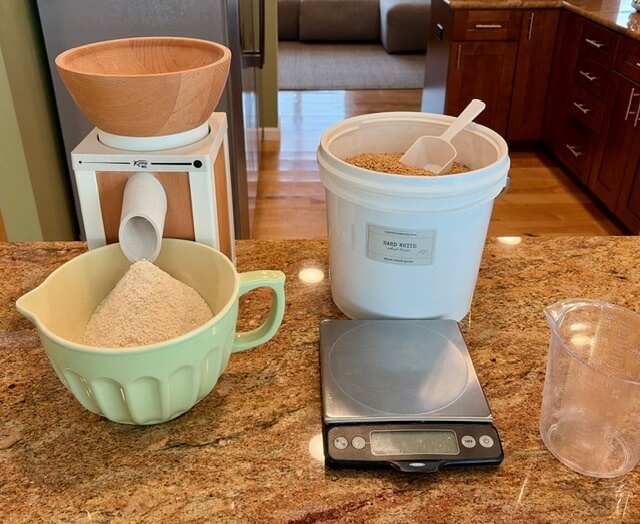
Grind until it becomes a fine, fluffy flour cloud.

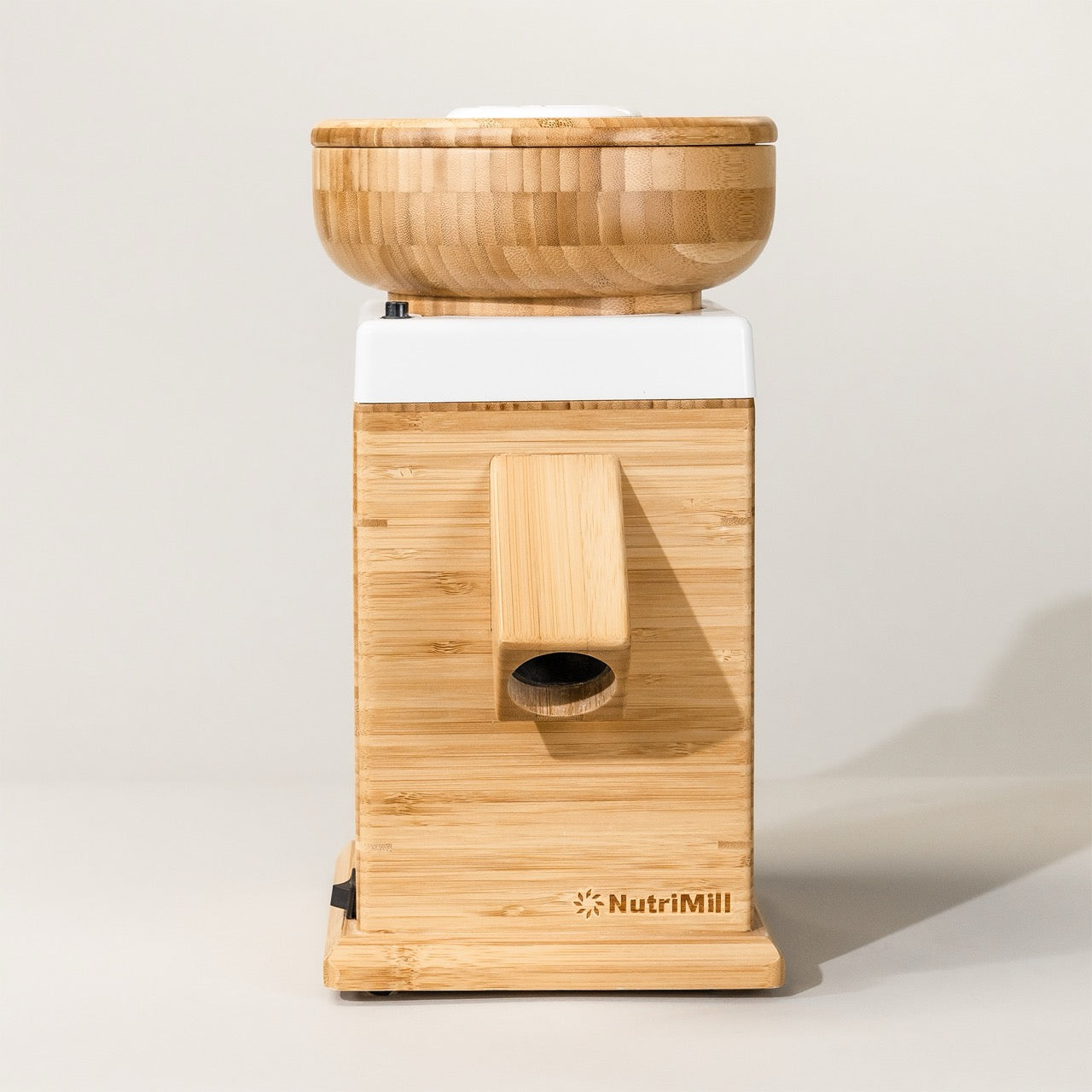
Grain Mill, Bowl, Bucket of wheat berries, scale for making freshly ground wheat

Store-Bought Flour Option for Fresh Milled English Muffin Skeptics

If you’re using store-bought flour, all-purpose flour works perfectly. No bread flour needed. These muffins don’t want intense gluten strength … they want tenderness and air.

If you’re curious about grinding your own wheat or why freshly ground flour english muffins are nutritionally superior, I’ve got links waiting for you.

Now … dough time.

Dough Time: English Muffins Choose Their Own Adventure

Pour your foamy yeast mixture into a mixing bowl. Then add:

  • 6 tablespoons melted butter

Give it a quick mix.

You might notice some recipes include an egg. I skip it. Why? Because eggs add extra fat and protein, which tightens the crumb. That’s lovely for sandwich bread … but terrible for nooks and crannies, which are the whole point of fresh milled english muffins.

Path One: Freshly Ground Flour English Muffins

Add:

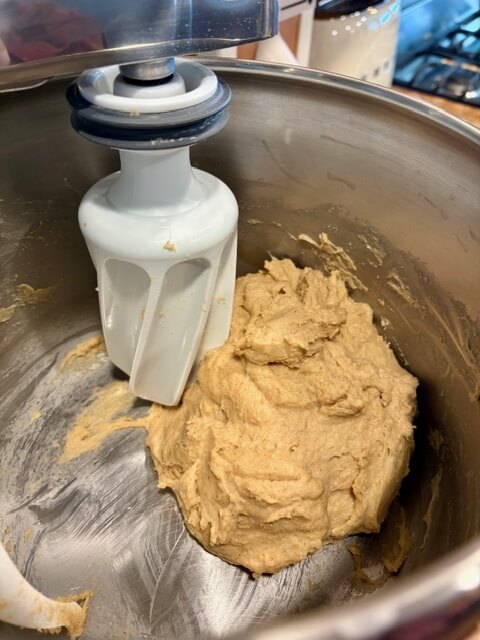
Mix for 6 minutes, which is intentionally shorter than you’d mix a bread loaf. At this stage, we’re not trying to build superhero gluten. Instead, we’re just introducing the ingredients, giving the flour a chance to meet the liquid, and lightly waking up the gluten network. In other words, think “gentle encouragement.” Strong gluten is wonderful for tall sandwich bread, but for fresh milled english muffins, it’s the enemy of those dreamy nooks and crannies.

Next, let the dough rest for 20 minutes. This pause may feel unnecessary, but it’s actually doing a lot of behind-the-scenes work. Fresh milled flour is thirsty … much thirstier than store-bought flour … because it hasn’t been pre-conditioned or treated with oxidizers. During this rest, the flour slowly absorbs the liquid, the bran softens, and the dough becomes more cooperative without extra mixing. Meanwhile, this hydration step helps improve extensibility, which means the dough can stretch more easily and trap bigger air pockets later.

After the rest, mix again for another 6 minutes. Now that the flour is fully hydrated, the gluten develops more efficiently with less effort. You’ll notice the dough starting to look smoother and slightly more elastic, but still relaxed and loose. That’s exactly where we want it.

The dough should feel wet, sticky, and just a little annoying to work with. If it’s truly miserable … like soup-level miserable … now you may add flour one tablespoon at a time. However, resist the urge to overcorrect. A wetter dough stretches more easily, and traps air more effectively. Translation? More nooks. More crannies. More english muffin joy.

dough in mixing bowl for fresh milled english muffins

Path Two: Store-Bought Flour English Muffins

Add:

  • 6 cups of all-purpose flour (until soft dough forms)
  • 2 teaspoons of salt

Mix and knead the dough for just a few minutes …  and yes, that really is enough. This is not the moment to channel your inner bread baker and knead like you’re training for a competition. With english muffins, our goal is simply to bring the dough together into something cohesive and smooth, not to fully develop an intense gluten network.

As you mix, you’re looking for a dough that’s soft, slightly elastic, and holding together nicely, but still relaxed. It should feel alive and pliable, not tight or springy.. Overdeveloped gluten traps gas too efficiently, which creates a tighter crumb … and tight crumbs are the sworn enemy of nooks and crannies.

Therefore, once the dough comes together and looks reasonably smooth, stop. Walk away. Back slowly if you must. Every extra minute of kneading at this point makes the interior more uniform and less interesting. And honestly, english muffins are supposed to be a little wild and imperfect inside … that’s part of their charm.

First Rise: Fresh Milled English Muffins Decide Their Schedule

Form your dough into a ball. Lightly oil your bowl, roll the dough around to coat, and cover it.

Now, you have options.

English Muffins (The Chill Route)

If you want to cook these tomorrow, skip the counter rise. Put the covered, oiled dough straight into the fridge. It can rest there for up to 24 hours. When you’re ready, pull it out, let it warm up, and allow it to double.

Same-Day English Muffins

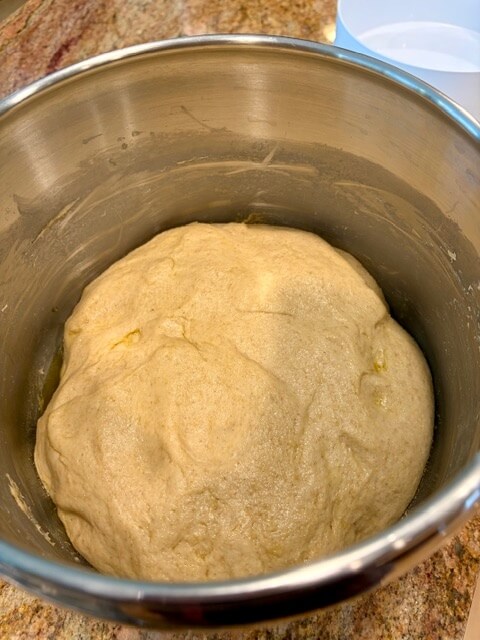
If you’re cooking today, let the dough rise in a warm spot until doubled … about 1 hour.

Either way, once doubled, we move on.

Dough that is risen for fresh milled english muffins

Press, Don’t Roll: Fresh Milled English Muffins are Delicate Creatures

Before our hands get dirty, line two baking sheets with parchment paper and set them aside. This is one of those small steps that feels optional, but it absolutely makes life easier later.

While your hands are still clean, grab a cereal bowl and add:

  • ¼ cup cornmeal

This bowl will be doing important work very soon, so keep it close.

Next, gently turn the dough out onto a lightly floured countertop. If the dough seems extra clingy, lightly dust the top of the dough as well … but use a soft hand. We’re aiming for “manageable,” not “buried.” The dough should still feel slightly sticky and cooperative, because that moisture is exactly what helps create those beautiful air pockets in fresh milled english muffins.

Now for an important rule: skip the rolling pin. Rolling pins are wonderful tools, but this is not their moment. Rolling compresses the dough and squeezes out the fragile gas bubbles that have been working so hard during the rise. And crushed bubbles mean fewer nooks and crannies … tragedy.

Instead, use your hands to gently press the dough into an even slab about 1 inch thick. Work slowly, coaxing rather than forcing, and try to keep the thickness consistent from edge to edge. This gentle handling protects the dough’s structure and sets your english muffins up for a tall, fluffy debut … which is exactly what we want.

Choosing Shapes for Fresh Milled English Muffins

Now comes a fun, slightly opinionated part: choosing the shape and size of your english muffins. 

Thankfully, there’s no wrong answer here … just different vibes.

4” Round Cutter

If you’re using a 4-inch cutter, you’ll end up with generously sized muffins that are perfect for towering breakfast sandwich situations that require structural integrity, or even a sneaky burger bun moment. These are hearty, impressive, and feel a little indulgent … like the english muffin that showed up dressed fancy for brunch.

3” Round Cutter

A 3-inch cutter, on the other hand, delivers that classic english muffin experience. This is the size most of us recognize, the one that fits neatly in the toaster and feels instantly familiar. If nostalgia had a shape, this would probably be it.

Square/Rectangle

No cutter at all? No problem. You can absolutely cut the dough into squares or rectangles using a bench knife or even kitchen scissors. This method is wonderfully practical and eliminates most scraps, which means no re-rolling. If you go this route, try to make sure that every side of each muffin has a clean, freshly cut edge.

That last part matters more than you might think. Fresh edges rise better, cook more evenly, and help the muffins puff up uniformly instead of slouching to one side. Clean cuts encourage even expansion all the way around … and ultimately, taller, lighter, happier english muffins with better nooks and crannies.

Cut (Don’t Squish) the Fresh Milled English Muffins

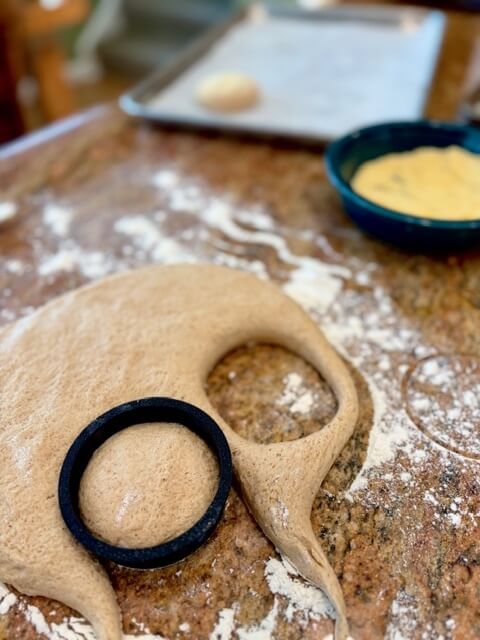
Before you start cutting, take a moment to flour or lightly grease your cutter. This small step prevents dragging, tearing, and sticking … all of which can interfere with how well your english muffins rise. A clean release gives the dough the best chance to puff straight up instead of slumping sideways.

When cutting, press straight down with steady pressure. No twisting, no spinning, no dramatic wrist action. Twisting might feel helpful, but it actually seals the edges of the dough, which restricts how much the muffins can rise. Sealed edges equal shorter, denser muffins … and we didn’t come this far for that.

Once cut, gently lift each muffin and dip it into the cornmeal, coating both the top and bottom. The cornmeal adds that classic texture, prevents sticking during cooking, and gives the muffins a little extra character. After dipping, place each one onto your parchment-lined baking sheet, leaving a bit of space between them.

Now gather the scraps and reshape them gently into a loose ball. Pat the dough back out to about 1 inch thick and cut again. Try not to knead or compress the scraps too much … we want to preserve as much trapped air as possible. The final muffins made from the very last bits may not rise quite as high or develop quite as many nooks and crannies, but let’s be honest: it will still be dramatically better than anything you can buy in a plastic bag.

Once your baking sheets are full, cover the muffins loosely and let them rise for about 30 minutes, or until they look puffy and slightly expanded. This short second rise gives the dough time to relax and build a little more gas, setting the stage for light, fluffy english muffins with plenty of personality.

Let’s Get Toasty: Cooking Fresh Milled English Muffins on the Stovetop

Heat a large skillet over medium-low heat and give it a few minutes to warm up properly. This step is not a race. English muffins … especially english muffins with freshly ground flour … thrive on gentle, even heat. Rushing this part is a way to end up with muffins that look perfect on the outside but are raw and doughy in the middle.

Now, a confession: I adore cast iron. Truly. However, for fresh milled english muffins, stainless steel wins every time. Cast iron retains heat so aggressively that it tends to brown the exterior far too quickly, long before the interior has a chance to cook through (at least on my gas stovetop). Stainless steel, on the other hand, is more responsive, making it much easier to keep the temperature low and steady.

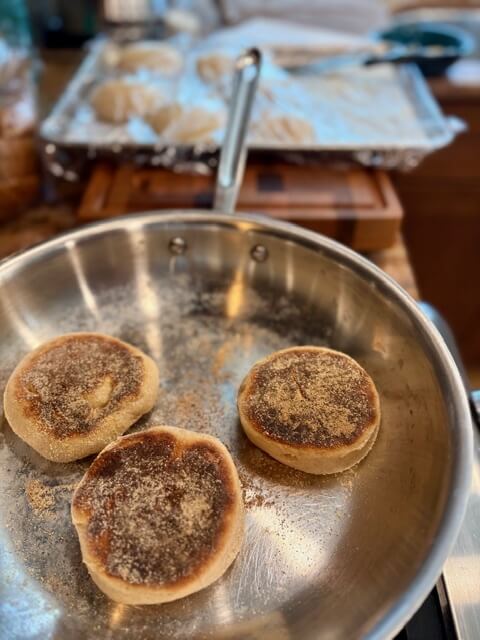
Once the pan is warm … you should be able to hold your hand a few inches above it and feel consistent heat … sprinkle a light layer of cornmeal onto the surface (you can use the leftover cornmeal from the bowl). Then add the muffins, leaving plenty of space between them. They will expand as they cook, and crowding them can lead to uneven browning.

Immediately cover the pan and reduce the heat to low. This is key. The lid traps steam, which helps cook the muffins all the way through while keeping the crust tender. Think of this step as a combination of griddling and gentle steaming.

Cook the first side for 6–8 minutes, undisturbed. Resist the urge to peek, press, or shuffle them around. The less you interfere, the more beautifully those nooks and crannies develop.

When the bottoms are golden, and the sides look slightly dry, flip gently … no smashing, no drama. Cook the second side for another 6–8 minutes. For certainty, the internal temperature should reach 190°F, signaling that your english muffins are fully cooked and ready for the next batch.

three fresh milled english muffins in a pan cooking

Emergency Fix for Fresh Milled English Muffins

Too dark outside, undercooked inside? Pop them into a 350°F oven for 10 minutes. Crisis averted.

Round Two (and Three… and Four) of Cooking your Fresh Milled English Muffins

Once the first batch is beautifully golden and cooked through, transfer those muffins to a wire rack to rest. 

Now it’s time for round two (and three… and four). Before adding more muffins to the pan, take a second to wipe out the old cornmeal. Burnt cornmeal can turn bitter and interfere with even browning. I usually grab a paper towel, wipe the cornmeal onto a dinner plate, and make sure the pan is clean.

Once the pan is clean, sprinkle in a fresh layer of cornmeal. Then, add the next batch of muffins and repeat the cooking process.

As you go, you may need to futz with the heat a bit. Maybe the pan needs to come down slightly, or maybe it needs a small bump back up. This is completely normal and honestly, part of the charm of making english muffins. Unlike baking in an oven, stovetop cooking requires you to pay attention, adjust, and respond … and once you’ve made them once, your instincts will kick in quickly.

Also, let me give you full permission to use two pans at once. It speeds everything up dramatically and gets warm english muffins onto your plate much faster.

Cool Them ... Use a FORK … Then Go Wild

Once all the muffins are cooked, let them cool on a wire rack. This pause matters more than it sounds. Resting allows excess steam to escape, prevents soggy bottoms, and helps the crumb finish setting so the muffins don’t collapse on themselves. Plus, it gives you a moment to admire your work … which is important for morale.

But if you are like me … you don’t want to wait. Go ahead and grab one from the first batch while it’s still a little warm. This is one of life’s small rewards, and you’ve earned it.

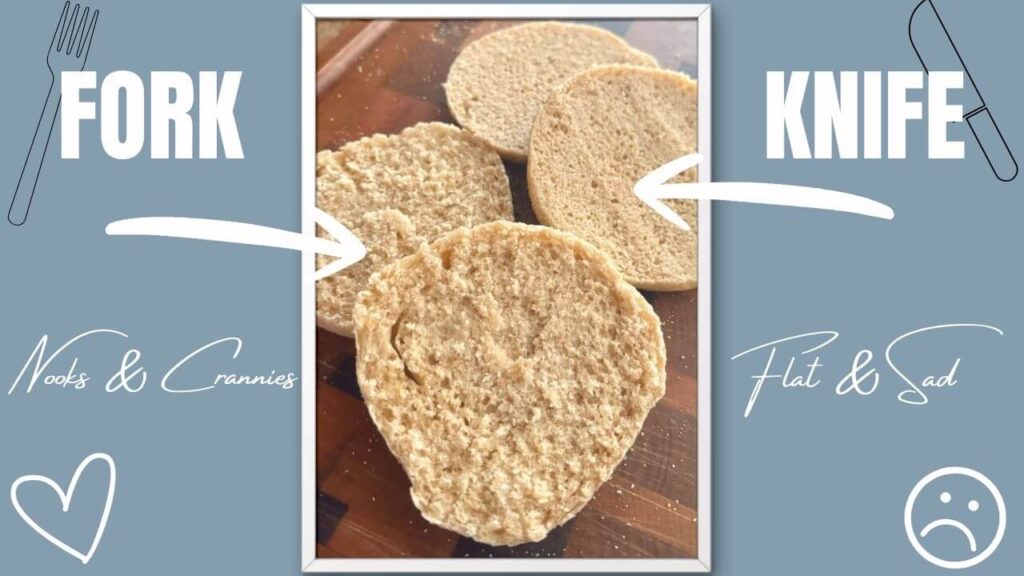
When it’s time to open it up, reach for a fork, not a knife. Yes, really. A fork is the secret weapon of great english muffins. The tines slide into the natural air pockets and gently pry the muffin apart along its own internal fault lines. This preserves those jagged, craggy interiors … the famous nooks and crannies.

A knife, while useful for many things, slices cleanly through the crumb. That clean cut flattens air pockets and smooths out the interior, which is the opposite of what we want here. (No hard feelings, knives. Today just isn’t your day.)

Once fork-split, pop the halves into the toaster until the edges turn golden and slightly crisp. Then add butter … generously, confidently, and without apology. Watch it melt into every crevice. Take a bite. Pause. Marvel at the fact that you made this with your own hands.

Picture of a fresh milled english muffin that is split with a fork and another that is split with a knife

FAQ: Fresh Milled English Muffins, Answered

Why Are English Muffins Different From Bread?

English muffins are cooked on a griddle or stovetop, rather than being baked in an oven. This low, steady heat allows the dough to cook gently from the outside in … while steam builds inside, creating those signature nooks and crannies. 

Why Didn’t My English Muffins Get Enough Nooks and Crannies?

This usually comes down to handling. Over-mixing the dough, rolling it out with a rolling pin, or pressing too firmly during shaping can knock out the air bubbles before they ever have a chance to shine. Another common culprit is slicing the muffins open with a knife instead of fork-splitting, which flattens the interior structure. Gentle mixing, light-hand with quantity of flour, and a fork are the trifecta for craggy interiors.

Why Are My English Muffins Dense or Flat?

Dense muffins are often the result of inactive yeast, dough that didn’t rise long enough, or cooking over heat that was too high. When the pan is too hot, the outside sets before the inside can expand, limiting rise and trapping the crumb in a tight structure. Low heat and patience are key.

How Should I Store Fresh Milled English Muffins?

Once fully cooled, store english muffins in an airtight container at room temperature for up to three days. For longer storage, split (with a fork, silly goose) them first, then freeze. They toast beautifully straight from frozen and taste just as good weeks later.

How Do You Eat English Muffins, Anyway?

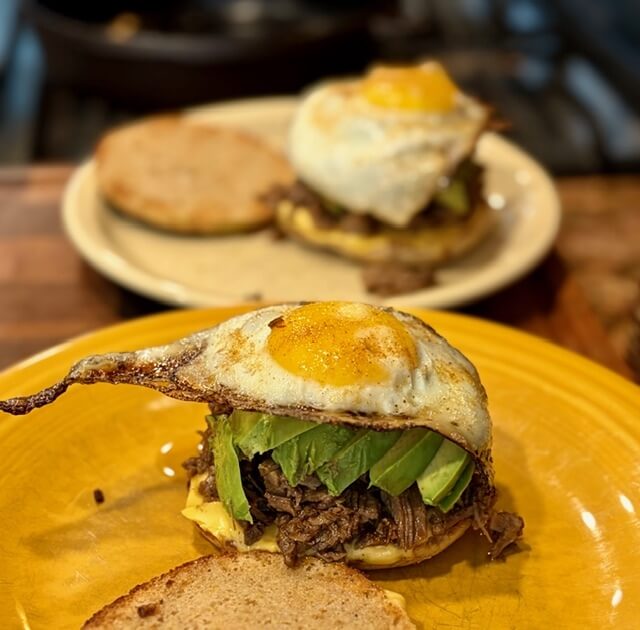
The short answer: with almost anything. Try them as egg sandwiches, burger buns, or slathered with jam, honey, peanut butter, cream cheese, or Nutella. They’re also the undisputed foundation of a proper eggs benedict.

What Flavor Variations Are Fun to Add?

Classic cinnamon-raisin is always a crowd-pleaser (grab my free recipe before it disappears into a breakfast black hole), but cheddar and chive sneak in with a savory plot twist your taste buds won’t see coming. Fresh herbs like rosemary, thyme, or oregano work beautifully, and pumpkin spice brings cozy fall vibes. Once you master the base, the variations are endless.

Conclusion of Our Fresh Milled English Muffin Journey

Homemade freshly milled flour english muffins are on a whole other level compared to anything you’ll find in a plastic bag at the grocery store. The flavor is richer, the texture is softer but still craggy, and the nooks and crannies? Unbeatable. Once you make them, there’s no going back. Seriously … eating store-bought after this feels… a little sad. You’ll start wondering why you ever settled.

At first, these muffins might seem intimidating. They look like something artisan, complicated, and utterly fussy. But here’s the secret: they really aren’t. After making them just once, you’ll realize that the steps are simple, forgiving, and actually kind of fun. And then, magic happens. Suddenly, you’re the person bringing muffins to brunch just because, handing them out as hostess gifts, and giving impromptu lectures on fork-splitting to anyone who will listen … strangers included. It’s a life upgrade, really.

Don’t leave empty-handed! Get your free recipe card for cinnamon-raisin muffins … the edible hug you didn’t know you needed

Before you split (forks only, obviously), poke around my other recipes, guides, and tutorials to keep your kitchen experiments fun, fearless, and fully buttered.

If you try these homemade english muffins …  fresh-milled flour or store-bought … leave a comment below, tag me on Instagram @hopethiswerksdiy, or come find me on Facebook. I’ll be cheering you on… probably while buttering another english muffin.

Want to make sure you never miss a recipe like this? Subscribe here and I’ll send you a printable recipe card for the best pancakes on earth as a thank-you gift (my Mom’s secret recipe).

Until next time … may your nooks be deep, your crannies be plentiful, and your toaster always be set just right. Cheers!

Yield: 3" = 18 Muffins ... or ... 4" = 10 Muffins

Fresh Milled English Muffins (yeast)

An freshly milled english muffin on a plate with eggs and jam in the background

These english muffins are made with freshly ground flour ... Expect nooks. Expect crannies. Expect obsession.

Ingredients

Instructions

    1. Activate the Yeast: Combine milk, water, and honey in a glass measuring cup. Warm to 110° (think warm bath, not hot tub ... for me this was 2½ minutes at 50% power in the microwave). Stir in the yeast and let it hang out for 5 minutes, until foamy and alive. (1½ cups milk, 1 cup water, ¼ cup honey, 4 tsp yeast)
    2. Freshly Milled Flour: While the yeast does its thing, grind the wheat berries to a fine consistency. (4 cups hard wheat berries)
    3. Make the Dough: Pour the milk mixture into a mixing bowl. Mix in the melted butter. Slowly add the flour while mixing on low, then add the salt. Increase to medium and mix for about 6 minutes (we are aiming for a wet dough with a looser gluten structure). Let it rest for 20 minutes (to hydrate). Then mix it again for 6 more minutes (if the dough is miserably wet, you can add a little more flour at this point). (6 tbsp butter, 2 tsp salt)
    4. First Rise: Lightly oil the mixing bowl, turn the dough to coat, and cover. Let rise in a warm spot until doubled, about 1 hour. Overnight option: Refrigerate the dough before you let it rise ... when it’s go-time, bring it out of the fridge and cut (note: the second rise in step 6 will take longer).
    5. Press, Don't Roll: Let's do some quick prep. Line two baking sheets with parchment paper, then grab a cereal bowl and add ¼ cup of cornmeal. Next, turn the dough onto a floured counter and gently pat it out to 1 inch thick, keeping it even. No rolling pin ... those nooks and crannies are fragile little creatures.
    6. Ready to Cut: Cut muffins with a 3" (or bigger or smaller ... use what you've got) round cutter (greased or floured). Don't twist the cutter ... just push down. Dip the top and bottom of the muffin in cornmeal. Gently gather scraps, re-pat, and cut again (these will have fewer crannies - but still very snack-worthy). Rest on the baking sheets. Cover loosely, and let rise until puffy, about 30 minutes.
    7. Cook (no oven!): Heat a large skillet over medium. When it feels hot a few inches above the surface, sprinkle with cornmeal and add a few muffins. Cover (to help steam them), reduce heat to low, and cook 6–8 minutes until bottoms are golden and sides start looking dry. Flip, cover, and cook another 6–8 minutes until browned. The goal is for the internal temperature to reach 190 degrees.
    8. More Muffins, Same Vibes: Wipe out the old cornmeal, add a fresh sprinkle to the pan, and cook the remaining muffins. You will probably need to futz with the heat a bit as you go ... this is normal and part of the charm.
    9. Cool, Split, Devour: Let cool slightly on a wire rack, then split with a fork (never a knife) and enjoy every cranny-filled bite.

Notes

  • Cinnamon Raisin: Feeling fancy? Click here for the free cinnamon raisin recipe. You won’t regret it.
  • Storage: Store in an airtight container at room temp for 4–5 days. For longer storage, freeze them ... future you will be very grateful.
  • Cast Iron: I love cast iron for basically everything… except these. On my gas stove, it’s hard to keep the heat low enough, so I usually grab a stainless steel pan instead.
  • Overnight Method: Want fresh English muffins in the morning with minimal effort? Same. After placing the dough in an oiled bowl (see step 4), cover and refrigerate up to 10 hours. When ready, turn it out cold, press, and cut ...no warming needed. Once cut, the second rise may take longer since the dough is cold. Wait until puffy and ready to cook.
  • Square English Muffins: Instead of a round cutter (in step 6), use a bench knife or kitchen scissors to cut the dough into a grid, making them your perfect size squares/rectangles.
  • Uncooked Middles? If the outsides are getting nice and brown but the insides aren’t quite done, pop the muffins into a 350°F oven for 10 minutes to finish cooking the centers. Problem solved.
  • Hurried (and Hungry)? Cook the english muffins in two pans at once to speed things up.

Recommended Products

As an Amazon Associate and member of other affiliate programs, I earn from qualifying purchases.

Yield: 3" = 18 Muffins ... or ... 4" = 10 Muffins

English Muffins with Store Flour (yeast)

An freshly milled english muffin on a plate with eggs and jam in the background

These english muffins bring nook, crannies, homemade swagger and breakfast joy! They'll have you wondering why you ever bought them in a plastic bag.

Ingredients

  • 1½ cups (430 g) milk
  • 1 cup (240 g) water
  • ¼ cup (85 g) honey
  • 4 tsp active dry yeast
  • 6 cups (720 g) all-purpose flour
  • 6 tbsp (85 g) butter, melted
  • 2 tsp salt
  • cornmeal or semolina, for dusting

Instructions

    1. Activate the Yeast: Combine milk, water, and honey in a glass measuring cup. Warm to 110° (think warm bath, not hot tub ... for me this was 2½ minutes at 50% power in the microwave). Stir in the yeast and let it hang out for 5 minutes, until foamy and alive. (1½ cups milk, 1 cup water, ¼ cup honey, 4 tsp yeast)
    2. Flour: All-purpose is perfect here ... you don’t want the strong gluten that bread flour brings to the party. (6 cups flour)
    3. Make the Dough: Pour the milk mixture into a mixing bowl. Mix in the melted butter. Slowly add the flour while mixing on low, then add the salt. Increase to medium and mix for about 6 minutes (we are aiming for a wet dough with a looser gluten structure ... if the dough is miserably wet, you can add a little more flour, a tablespoon at a time). (6 tbsp butter, 2 tsp salt)
    4. First Rise: Lightly oil the mixing bowl, turn the dough to coat, and cover. Let rise in a warm spot until doubled, about 1 hour. Overnight option: Refrigerate the dough before you let it rise ... when it’s go-time, bring it out of the fridge and cut (note: the second rise in step 6 will take longer).
    5. Press, Don't Roll: Let's do some quick prep. Line two baking sheets with parchment paper, then grab a cereal bowl and add ¼ cup of cornmeal. Next, turn the dough onto a floured counter and gently pat it out to 1 inch thick, keeping it even. No rolling pin ... those nooks and crannies are fragile little creatures.
    6. Ready to Cut: Cut muffins with a 3" (or bigger or smaller ... use what you've got) round cutter (greased or floured). Don't twist the cutter ... just push down. Dip the top and bottom of the muffin in cornmeal. Gently gather scraps, re-pat, and cut again (these will have fewer crannies - but still very snack-worthy). Rest on the baking sheets. Cover loosely, and let rise until puffy, about 30 minutes.
    7. Cook (no oven!): Heat a large skillet over medium. When it feels hot a few inches above the surface, sprinkle with cornmeal and add a few muffins. Cover (to help steam them), reduce heat to low, and cook 6–8 minutes until bottoms are golden and sides start looking dry. Flip, cover, and cook another 6–8 minutes until browned. The goal is for the internal temperature to reach 190 degrees.
    8. More Muffins, Same Vibes: Wipe out the old cornmeal, add a fresh sprinkle to the pan, and cook the remaining muffins. You will probably need to futz with the heat a bit as you go ... this is normal and part of the charm.
    9. Cool, Split, Devour: Let cool slightly on a wire rack, then split with a fork (never a knife) and enjoy every cranny-filled bite.

Notes

  • Cinnamon Raisin: Feeling fancy? Click here for the free cinnamon raisin recipe. You won’t regret it.
  • Storage: Store in an airtight container at room temp for 4–5 days. For longer storage, freeze them ... future you will be very grateful.
  • Cast Iron: I love cast iron for basically everything… except these. On my gas stove, it’s hard to keep the heat low enough, so I usually grab a stainless steel pan instead.
  • Overnight Method: Want fresh English muffins in the morning with minimal effort? Same. After placing the dough in an oiled bowl (see step 4), cover and refrigerate up to 10 hours. When ready, turn it out cold, press, and cut ...no warming needed. Once cut, the second rise may take longer since the dough is cold. Wait until puffy and ready to cook.
  • Square English Muffins: Instead of a round cutter (in step 6), use a bench knife or kitchen scissors to cut the dough into a grid, making them your perfect size squares/rectangles.
  • Uncooked Middles? If the outsides are getting nice and brown but the insides aren’t quite done, pop the muffins into a 350°F oven for 10 minutes to finish cooking the centers. Problem solved.
  • Hurried (and Hungry)? Cook the english muffins in two pans at once to speed things up.

Recommended Products

As an Amazon Associate and member of other affiliate programs, I earn from qualifying purchases.
English Muffin Process Flow

  1. Warm liquids to 110°F — Optimal temperature for yeast activation without killing it.
  2. Activate yeast until foamy — Confirms yeast viability and jumpstarts fermentation.
  3. Mix dough (short initial mix) — Combine ingredients without developing strong gluten.
  4. Rest dough (hydration phase) — Allows freshly milled flour to fully absorb moisture.
  5. Final mix (light gluten development) — Strengthen structure gently while preserving tenderness.
  6. First rise — Dough ferments at room temperature or via cold ferment for flavor.
  7. Press dough (no rolling pins!) — Maintains internal air pockets needed for nooks and crannies.
  8. Cut muffins (no twisting) — Clean cuts support vertical rise and even cooking.
  9. Cornmeal coat — Prevents sticking and adds classic English muffin texture.
  10. Second rise (30 minutes) — Muffins relax and puff before cooking.
  11. Cook on stovetop (covered, low heat) — Griddle cooking creates soft interiors and structured exteriors.
  12. Cool on rack — Steam escapes to prevent gumminess.
  13. Fork-split and toast — Preserves natural air pockets and enhances texture.

Ingredient Overview

Ingredient Purpose Notes
Milk Hydration & tenderness Warmed to activate yeast
Water Hydration Combined with milk
Honey Sweetener & yeast food Encourages fermentation
Yeast Leavening Active dry or instant
Butter Fat & flavor Melted
Freshly milled flour Structure & nutrition Hard wheat preferred
All-purpose flour Alternative option Store-bought substitute
Salt Flavor & control Essential for balance
Cornmeal Texture & release Prevents sticking

Flour Comparison

Feature Freshly Milled Flour Store-Bought Flour
Hydration needs High Moderate
Gluten development Slower Faster
Nutritional value Higher Lower
Flavor Rich, nutty Neutral
Conditioning None Pre-conditioned
Best wheat type Hard red / hard white All-purpose
Illustration about how to fork split a fresh milled english muffin versus using a knife

Resources:     https://preppykitchen.com/english-muffins/      https://www.kingarthurbaking.com/blog/2021/11/18/navigating-the-nooks-and-crannies

If this post made you smile, help me keep my grain mill spinning and my apron permanently dusty … you could tip me with this link. Thanks, you’re the best!

Share the Post:

4 responses to “Fresh Milled English Muffins with Yeast (Soft & Nooks-and-Crannies!)”

  1. I can confirm that these are exactly what you want them to be! Delicious! Thank you for such a great recipe with crannies and all!!

  2. A morning staple “made better”
    I love the idea of making them myself.
    Actually any excuse to have melting butter 😁

Leave a Reply

Your email address will not be published. Required fields are marked *

Skip to Recipe